Introducing Phonic-1 and our $27.5M Series A

October 29, 2026
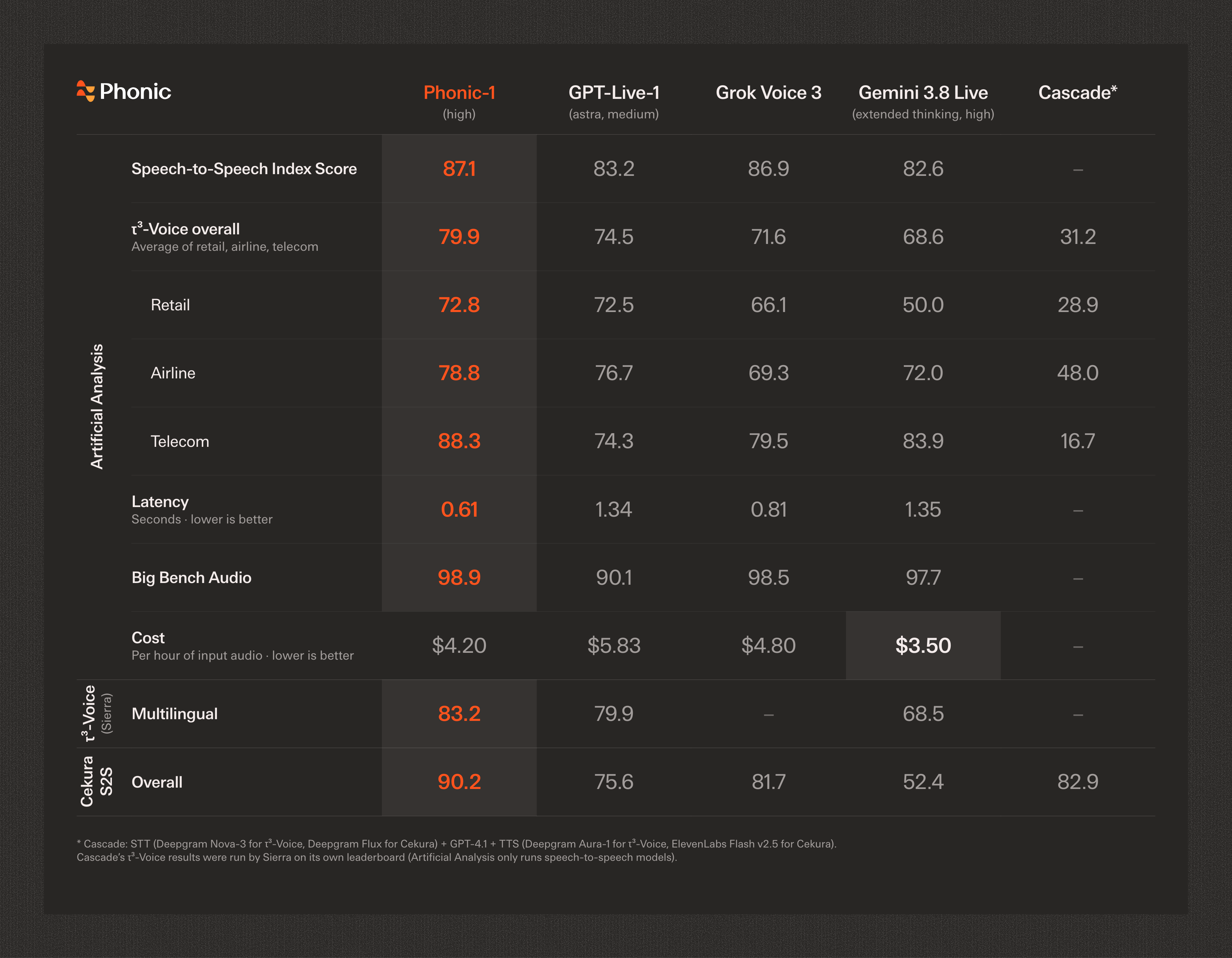
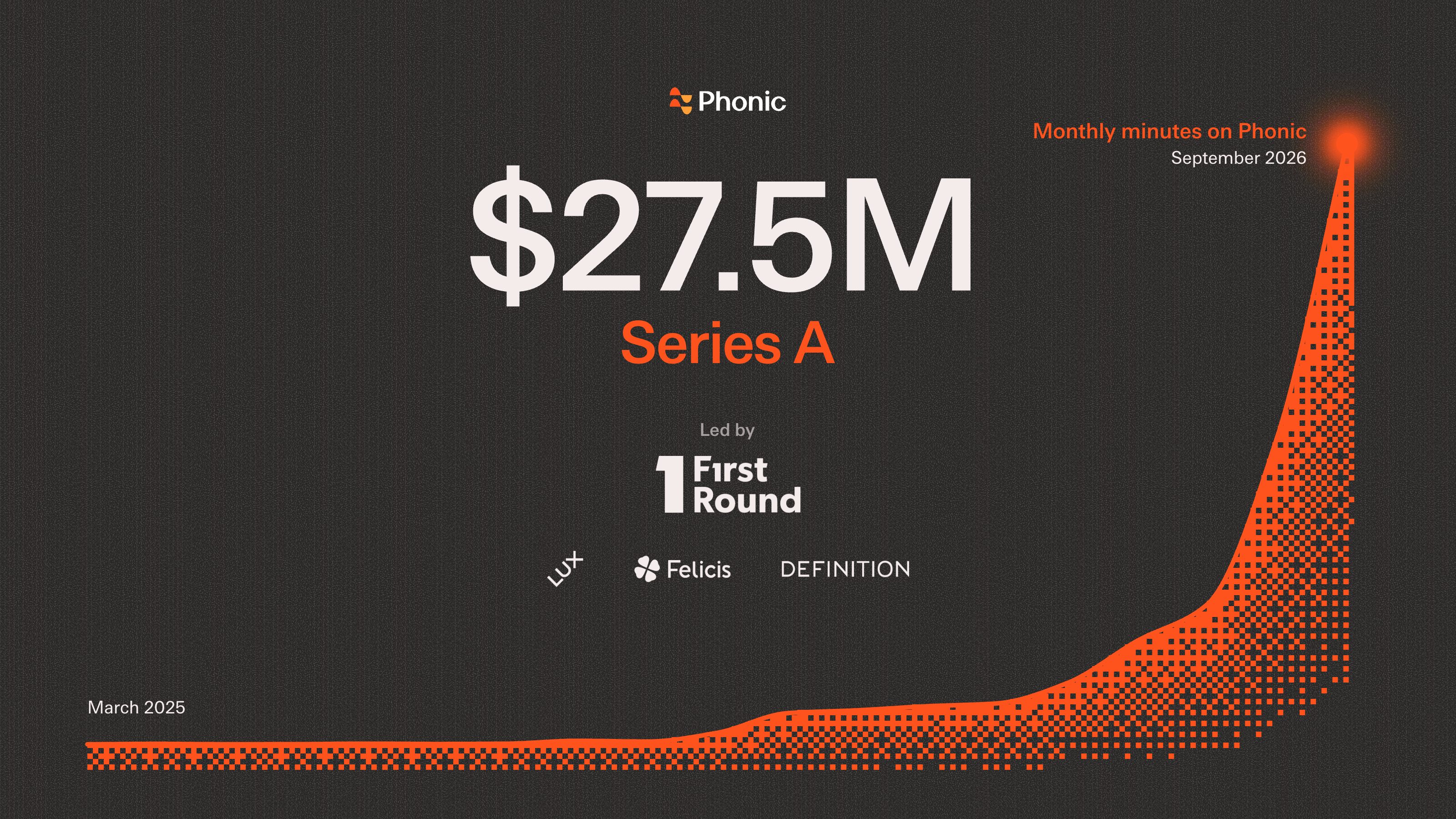
Today we're introducing Phonic-1, the most advanced speech-to-speech model for agentic tasks. Phonic-1 captured the number one spot on the Artificial Analysis Speech to Speech Index and delivers the highest task success rate on agentic tasks at the lowest latency. We're also announcing our $27.5M Series A, led by First Round with participation from Lux Capital, Felicis, and Definition, bringing our total funding to date to $31.5M.
The end state of voice is speech-to-speech
Most voice agents today are assembled from parts: one model transcribes the caller, another decides how to respond, and a third speaks the response aloud. This cascade was the first step in bringing voice AI into production, but a transcript is a lossy copy of a conversation — it drops the frustration in a caller’s voice, the long pause before an answer, even the way someone says their own name.
Speech-to-speech models lose nothing in translation, but until now, they’ve made you trade intelligence for naturalness. Demos can be remarkable, but few of these models make it into production.
We've been focused exclusively on speech-to-speech since founding Phonic more than two years ago. We believe building at the frontier means working deeply with the teams we serve, because the thorniest problems in voice only show up in real calls. Solving them has meant rethinking every layer of the stack: data, pre-training, RL, kernels, and infrastructure. Phonic-1 is the result.
Takes action while the caller is talking
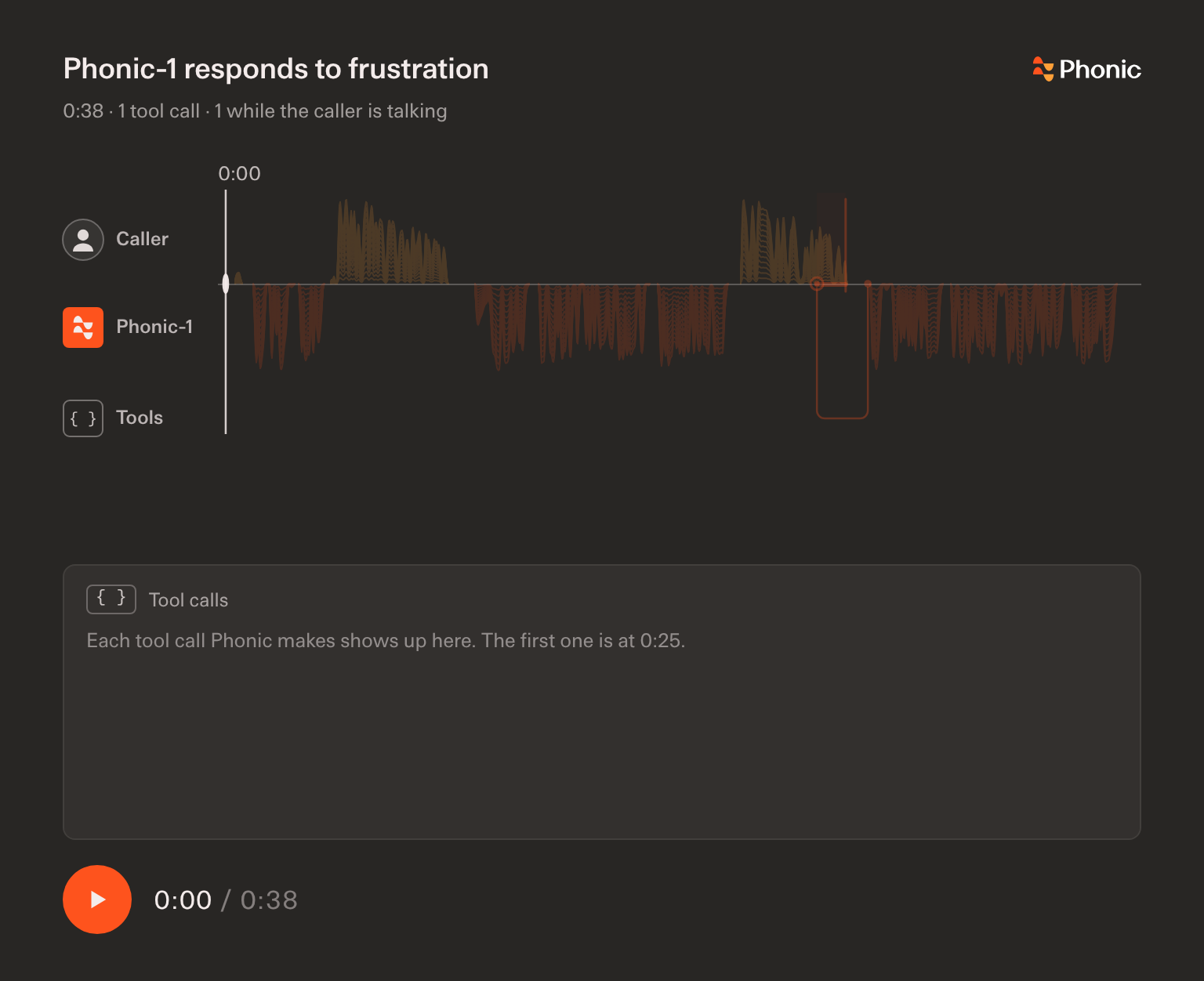
Other models wait for the caller to finish, say “let me look that up,” and only then call a tool. Phonic-1 is the only model that can act while the caller is still talking, so the answer is ready when they stop.

Frontier intelligence in real-time
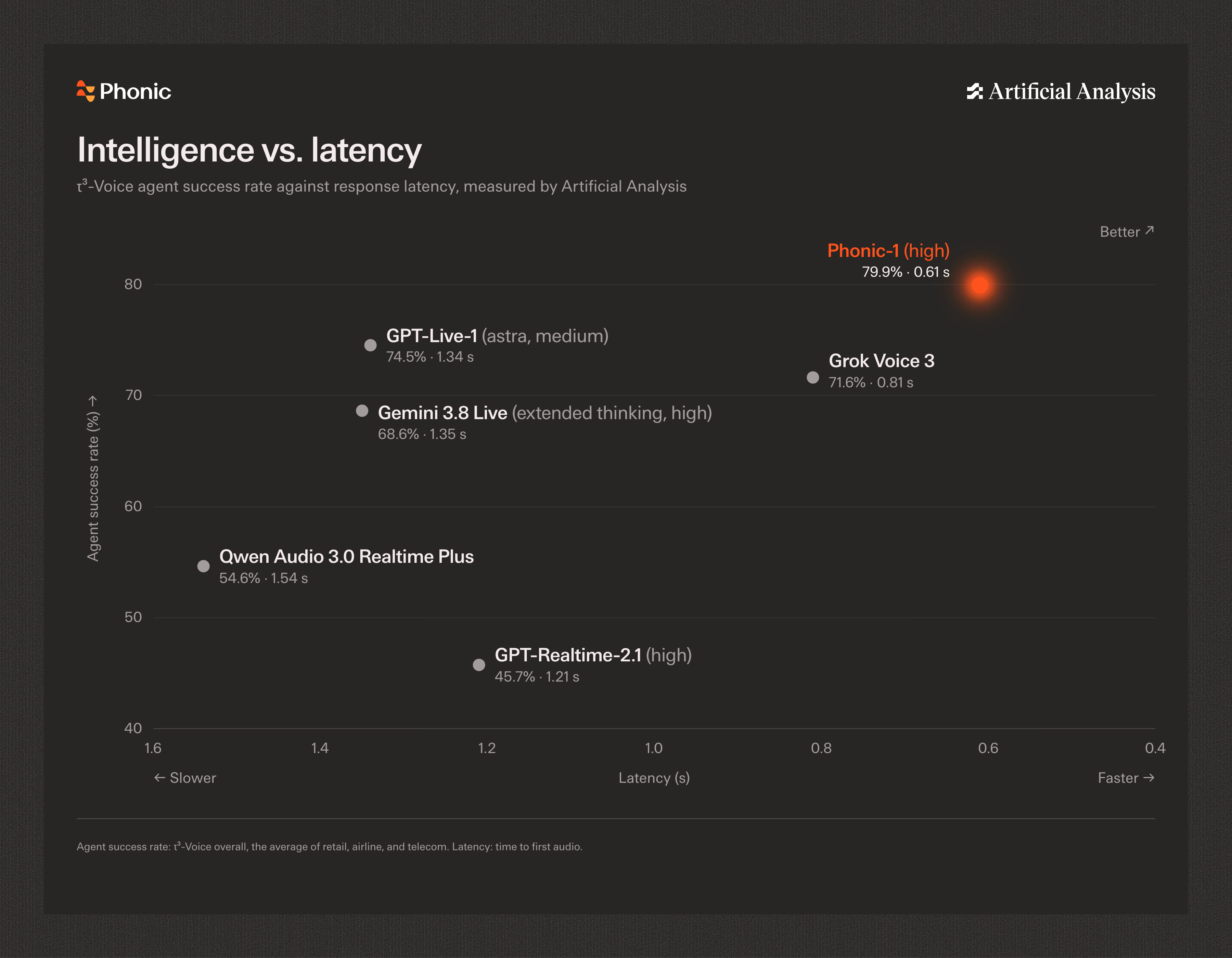
Phonic-1 is extremely fast. On end-to-end full-duplex benchmarks, it stands alone on the Pareto frontier of intelligence and latency.
Incredibly natural
We post-trained Phonic-1 for natural conversation, so it understands tone, handles turn-taking in noisy environments, and responds the way a person would.

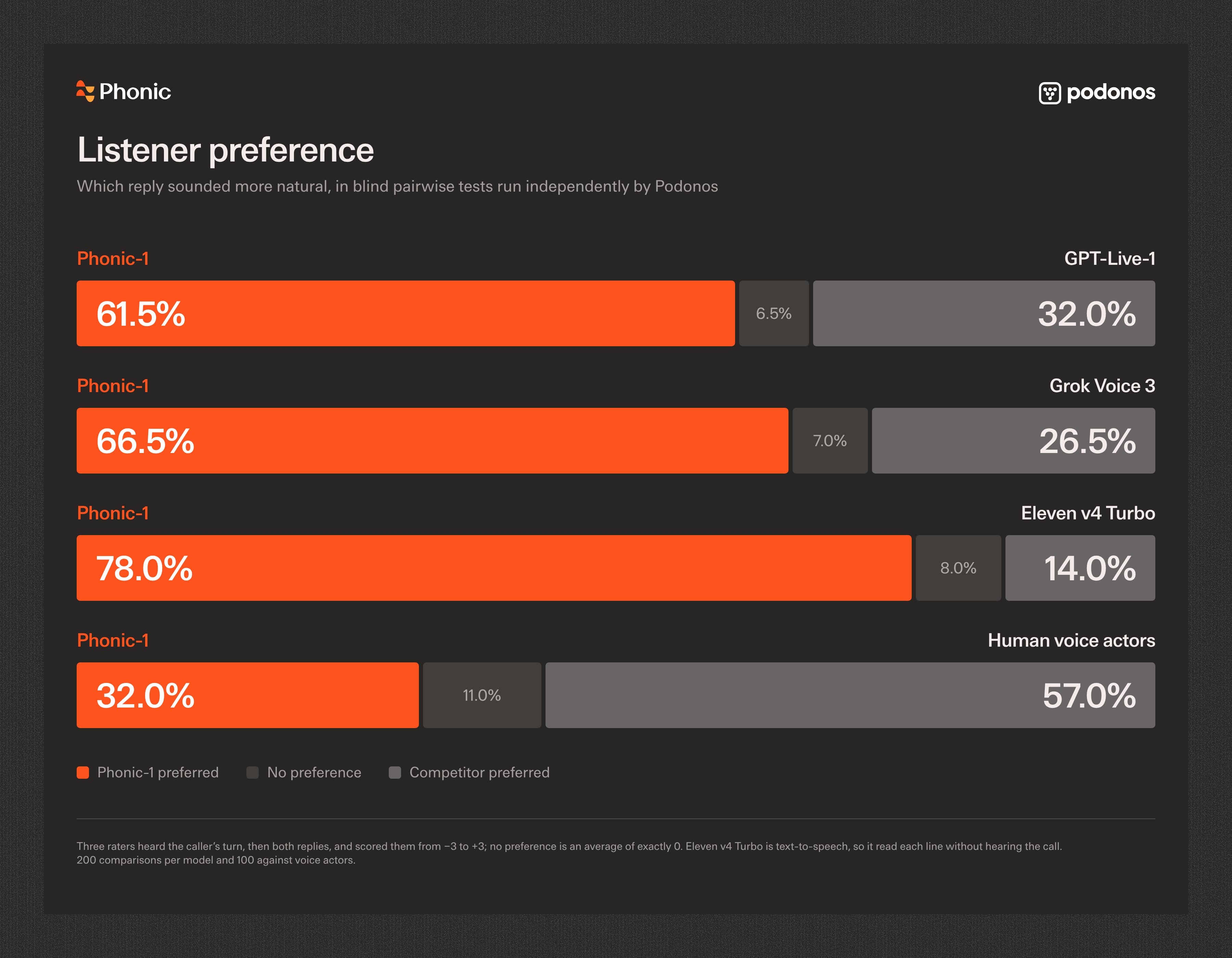
In blind human evaluations run by a third party, judges listened to how different models responded to a caller’s audio and preferred Phonic-1 the majority of the time. We also compared Phonic-1 against humans, and there’s still substantial room to improve on naturalness — humans win ~60% of the time. This is a core research direction we hope to make progress on with future models.
Expertly multilingual
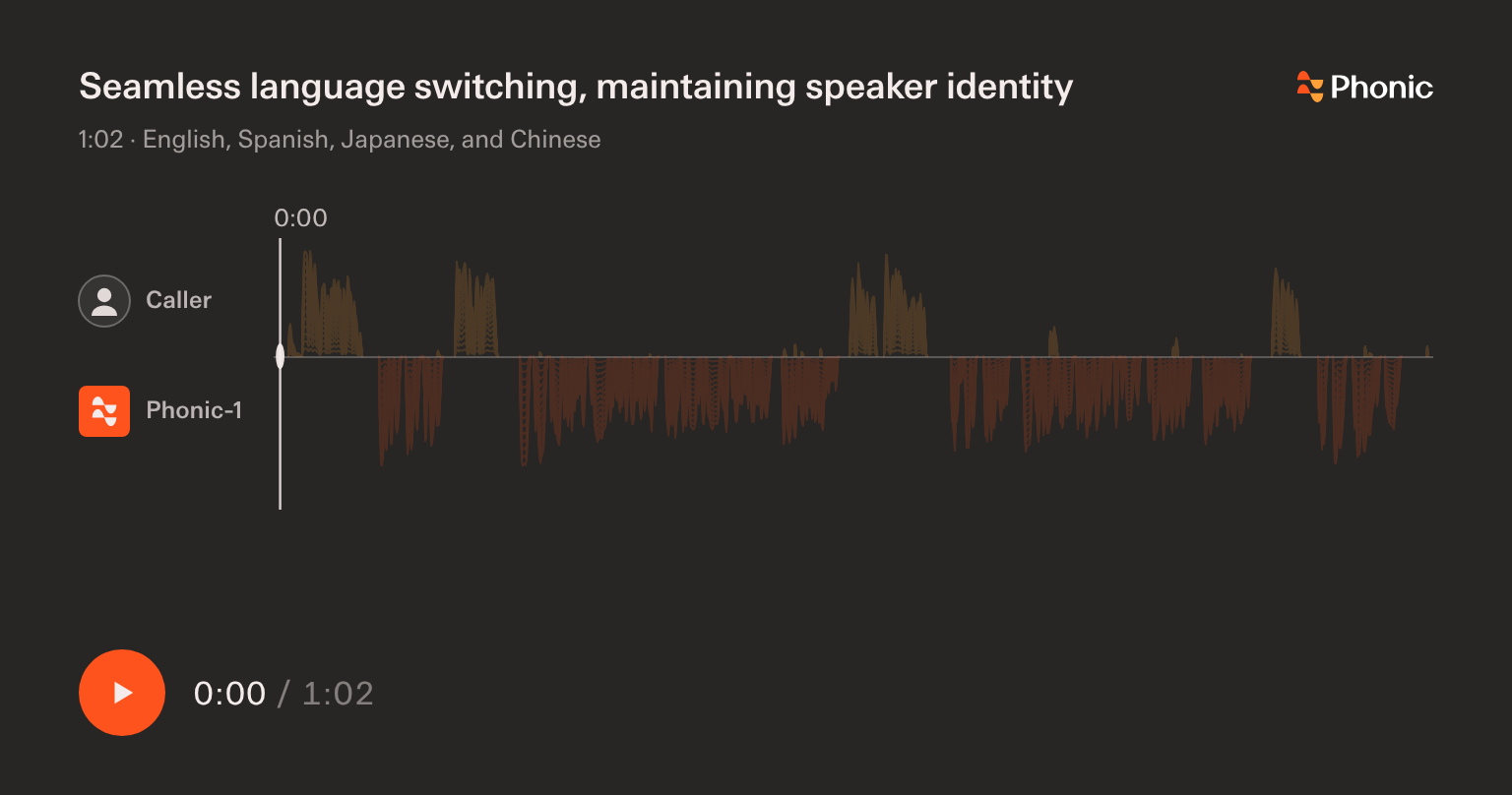
Phonic-1 is trained on 50+ languages and can switch languages mid-conversation while keeping the same speaker identity. It also performs well on multilingual full-duplex benchmarks — Phonic-1 scores an 83.2 on Sierra’s multilingual full-duplex τ³-Voice, outperforming GPT-Live-1 at 79.9 and Gemini 3.8 Live at 68.5.
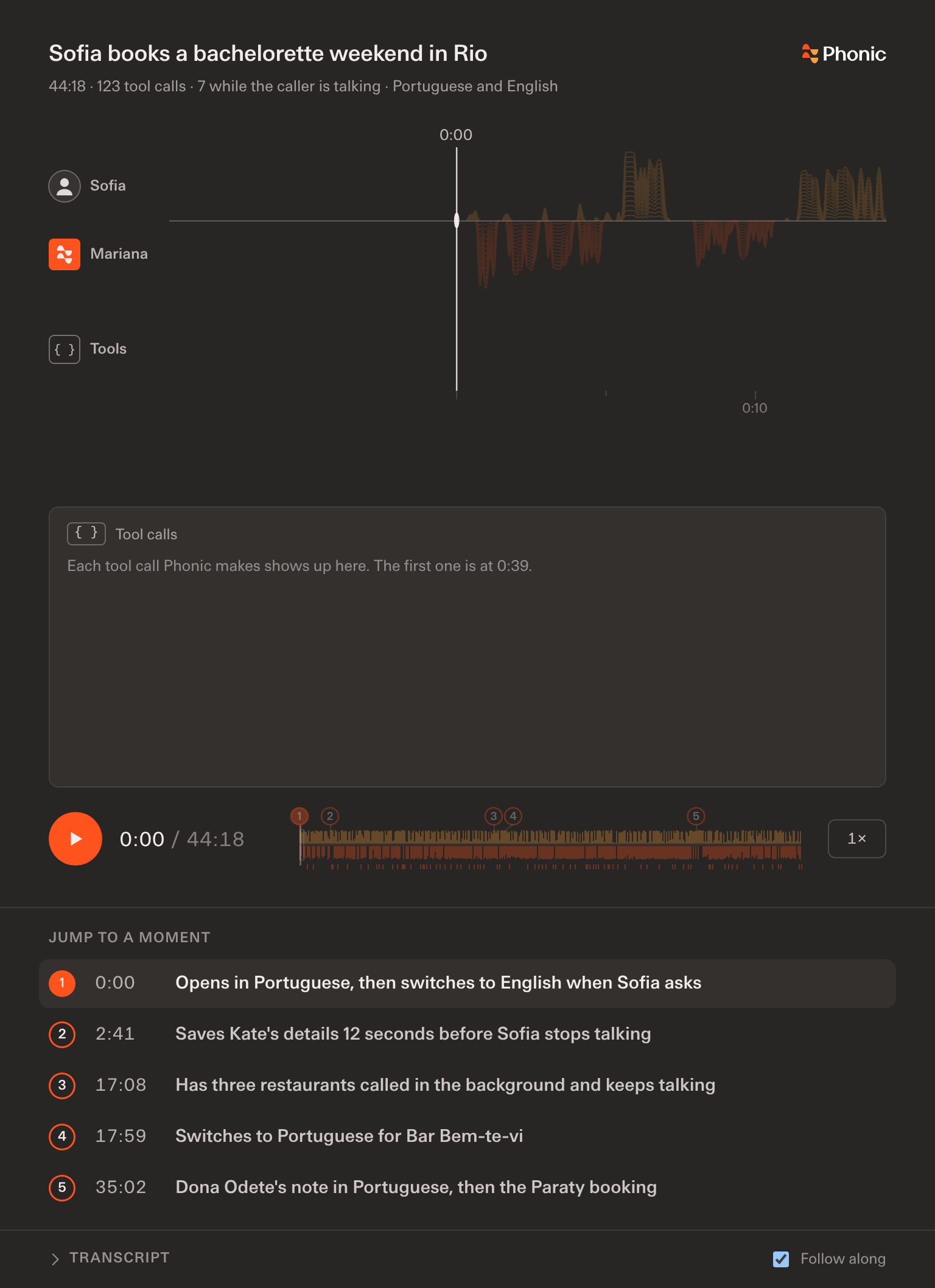
A 44-minute call with 123 tool calls
A maid of honor calls a hotel in Brazil to get help booking a bachelorette party. Phonic-1 picks up the phone.
Listen below, or see it in the Phonic platform with its transcript, per-turn latencies, and every tool call.
New funding to scale speech-to-speech in production
We've had a breakout year, and Phonic now powers calls across six continents for companies like Ashby, Maven AGI, Rho, and a Fortune 50 IT infrastructure company. Across customer support, healthcare, recruiting, and logistics, teams that have switched to Phonic are seeing higher customer satisfaction and the ability to handle more complex tasks.
“We came to Phonic for the model and found a great partner. The speech-to-speech model was ready for production, and its voices are some of the most natural we’ve heard. This creates a better candidate experience and more accurate read for the teams using Ashby to hire. Today, Phonic powers our AI interviews in 25 countries.”
Abhik Pramanik, Co-founder & VP of Engineering, Ashby
To fuel this growth, we raised a $27.5M Series A led by First Round, with participation from Lux Capital, Felicis, Definition, and Essence VC. We're also backed by angel investors including Erik Bernhardsson (Modal), Clement Delangue (Hugging Face), Arash Ferdowsi (Dropbox), Amjad Masad (Replit), Gokul Rajaram, Guillermo Rauch (Vercel), Naval Ravikant (AngelList), and Qasar Younis (Applied Intuition).
Put Phonic-1 to the test
Phonic-1 is available today, with $250 in free credits if you sign up by November 30. Already live with voice? Customers have switched to Phonic from cascaded stacks on ElevenLabs, Bland, and others. If you switch, three months are on us.
Join us
We're still in the early innings of voice. Every era of computing has brought its own interface, from the command line to the touchscreen, and each one has made us work on the computer's terms: typing commands, tapping through menus, filling in forms. Voice lets us talk to computers the way we talk to each other. As quality improves, use cases will grow in ways most people still underestimate.
We’re a small team of researchers and engineers from MIT, Stanford, and CMU, including International Olympiad medalists and former founders. There's a lot left to build. We’re hiring rapidly across research, engineering, product, and business roles. If you're as obsessed with the frontier of voice AI as we are, we'd love to hear from you.